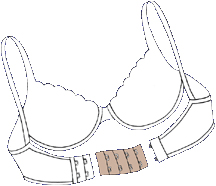
This question gets answered too quickly in both directions. The honest position is that there is a real anatomical reason bras exist, there are practical reasons to wear one, and there is a serious body of argument that wearing one is a social expectation rather than a physical need. All three are worth setting out properly.
The anatomy
Breasts contain no muscle. They are made of glandular and fatty tissue held by connective tissue and ligaments, which means they have no support mechanism of their own.
That single fact is the whole anatomical basis for the garment. A bra provides support, lift and control that the body does not supply internally, and it transfers that load to the ribcage and shoulders.
The practical case
Beyond support, bras solve specific problems that come up in ordinary life.
- Comfort during movement. Unsupported tissue moves independently of the body, which is uncomfortable at higher levels of activity and is the reason sports bras exist as a separate category.
- Shape under clothing. Many garments are cut on the assumption that a bra is being worn, and hang differently without one.
- Specific needs. Nursing and maternity bras solve genuine problems that have nothing to do with appearance.
- Social occasions. Some settings simply expect it, and that expectation is real whether or not it is justified.
The case against
There are also reasons not to wear one, and they deserve to be stated rather than skipped.
Many bras are uncomfortable, and a badly fitting one is worse than none. Tightness at the band, pressure from underwires and strap digging are all common, and a great deal of it is a fit problem rather than an inherent property of the garment.
More fundamentally: for most women, wearing a bra is not a necessity for the sake of the breasts themselves. The claim that bras prevent sagging is widely repeated and not well supported. Wearing one is, to a substantial degree, cultural and social conditioning rather than a medical requirement.
The feminist critique
A long-standing line of argument questions the value of the garment altogether.
The position holds that breasts were better left natural and unbound, and that bras have not shaped them but deformed them. On this view the bra functions as a symbol of the oppression and repression of women’s bodies, designed to conform to male expectations of what is desirable rather than to serve the wearer.
The broader point being made is about the body itself. The argument is that the feminine form, and the breasts in particular, is no longer treated as natural but is aesthetically shaped to meet a social ideal, and that the ideal is defined by conformity to what men find desirable. Wearing a bra, on this reading, is largely about being socially accepted.
The symbolism has a specific history. Feminists symbolically discarded their bras in the 1960s, and going bra-less is still frequently read as a feminist statement. The top freedom movement continues to question both the social and the medical relevance of the garment.
Where this leaves the decision
It is a personal choice, and it is reasonable to treat it as one. Some people are more comfortable without a bra and some are more comfortable with one, and that difference is genuine rather than a matter of getting it right or wrong. Individual preference, perception and habit all play a part.
What is worth separating is discomfort caused by the garment from discomfort caused by the fit. A great many people who conclude that bras are unbearable have never worn one in their actual size. If you are deciding, it is worth checking your bra size and what a properly fitting bra should feel like before making the call.
Frequently asked questions
Do bras prevent sagging?
This is commonly claimed and is not well supported. Bras provide lift while worn. The idea that wearing one prevents long-term change is a perception rather than an established fact.
Is it unhealthy to go without a bra?
For most women it is not a health issue. Wearing a bra is not a necessity for the sake of the breasts themselves.
Why do breasts need support at all?
Because they contain no muscle. Support comes from connective tissue and ligaments only, so there is nothing that can be strengthened to do the job internally.
Is a sports bra different?
Yes, and it addresses a genuine practical problem. It controls movement during activity, which is the clearest functional case for wearing one.