An armlet is an ornament worn around the upper arm, fitting closely against it. It is also known as an arm band, and in India as the baju bandh. Unlike a bracelet, which hangs loose at the wrist, an armlet has to grip in order to stay in place, and that requirement shapes almost everything about how it is made.
Who wears it
The armlet was traditionally worn by both men and women. In contemporary use it is worn mostly by women, though the older tradition is visible in classical sculpture and painting across a very long period.
Materials
Armlets are made in a wide range of materials, from precious metals through to modern industrial ones. The usual list runs to gold, silver, platinum, steel, glass and plastic.
The choice of material affects more than appearance. Metal armlets can be shaped to grip the arm and adjusted slightly by the wearer. Rigid materials such as glass cannot be, so those depend entirely on being the right size to begin with.
Designs
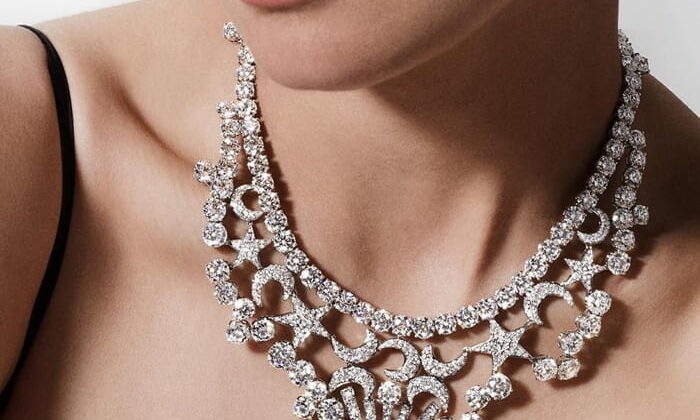
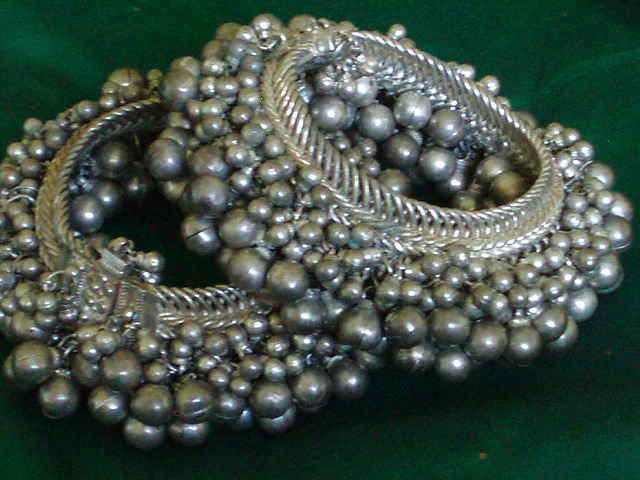
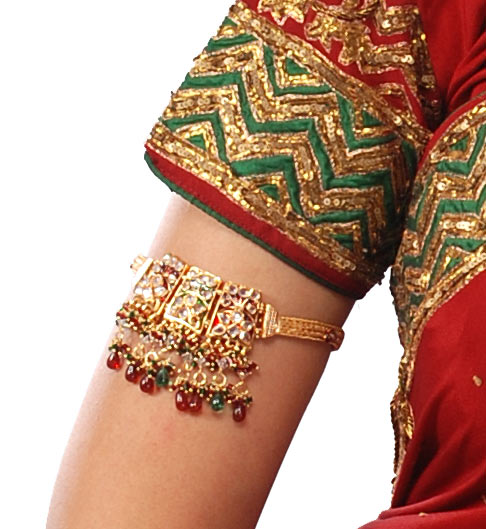
Armlets are available in an extensive variety of designs, shapes and sizes. The form ranges from a plain narrow band through to broad, heavily worked pieces that cover a considerable part of the upper arm.
Traditional Indian designs frequently carry the same decorative vocabulary as other jewelry worn with formal dress, so an armlet is usually chosen to sit within a set rather than as an isolated piece.
What to wear it with
The armlet adds an elegant touch to traditional attire, and it is at its most effective with sarees and with lehenga choli at formal occasions and weddings.
There is a practical reason it belongs with these outfits specifically. An armlet only works when the upper arm is visible, so it needs a sleeveless or short-sleeved blouse, or a drape that leaves the arm exposed. A long sleeve hides the piece entirely.
Getting the fit right
Fit is the whole problem with armlets, and it is worth taking seriously.
- It must grip to stay up. The upper arm tapers, so anything loose slides down toward the elbow within minutes.
- It must not constrict. Too tight is both uncomfortable and visibly unflattering, since it marks the arm.
- Position it high. An armlet sits best on the widest part of the upper arm or just above it, where the taper works in its favor.
- Adjustable is safer. Pieces with a tie cord, a spring band or an open coiled construction accommodate a range of arms; a fixed rigid band does not.
Frequently asked questions
What is a baju bandh?
The Indian name for the armlet, the ornament worn around the upper arm.
Which arm should an armlet be worn on?
Either, and it is a matter of preference. Some traditional sets are designed as a pair to be worn on both.
How do I stop an armlet sliding down?
Fit is the answer. It has to sit high enough on the upper arm that the taper holds it, and it has to grip. Adjustable and coiled designs are far more reliable than fixed bands.
Can armlets be worn with modern clothes?
Yes, provided the upper arm is bare. A plain metal band works with a sleeveless dress as easily as a worked piece does with a saree.